The Self-Service Booking Platform

Impact
37%
of bookings via self-service booking (vs expected 10-13%)
$190M
sales goal achieved in the first three months of launch
9%
task completion rate (booking funnel only)
Booking a yacht voyage isn't like booking a hotel room or an flight
Most booking platforms are built around a single assumption: one person, one room, one payment. Four Seasons Yachts breaks all three.
Guests travel in groups — multi-generational families, groups of couples, close friends with very different budgets. Some bring a personal assistant. Some want connected suites. Some are being bookedfor, not booking themselves. And at the price point of a luxury superyacht charter, the financial decisions are rarely simple or immediate.
Design tensions we had to solve
Who is actually booking — and for whom?
How do you handle a group that doesn't travel as one?
When does someone actually pay — and how much?
What does "my booking" mean after you've booked?
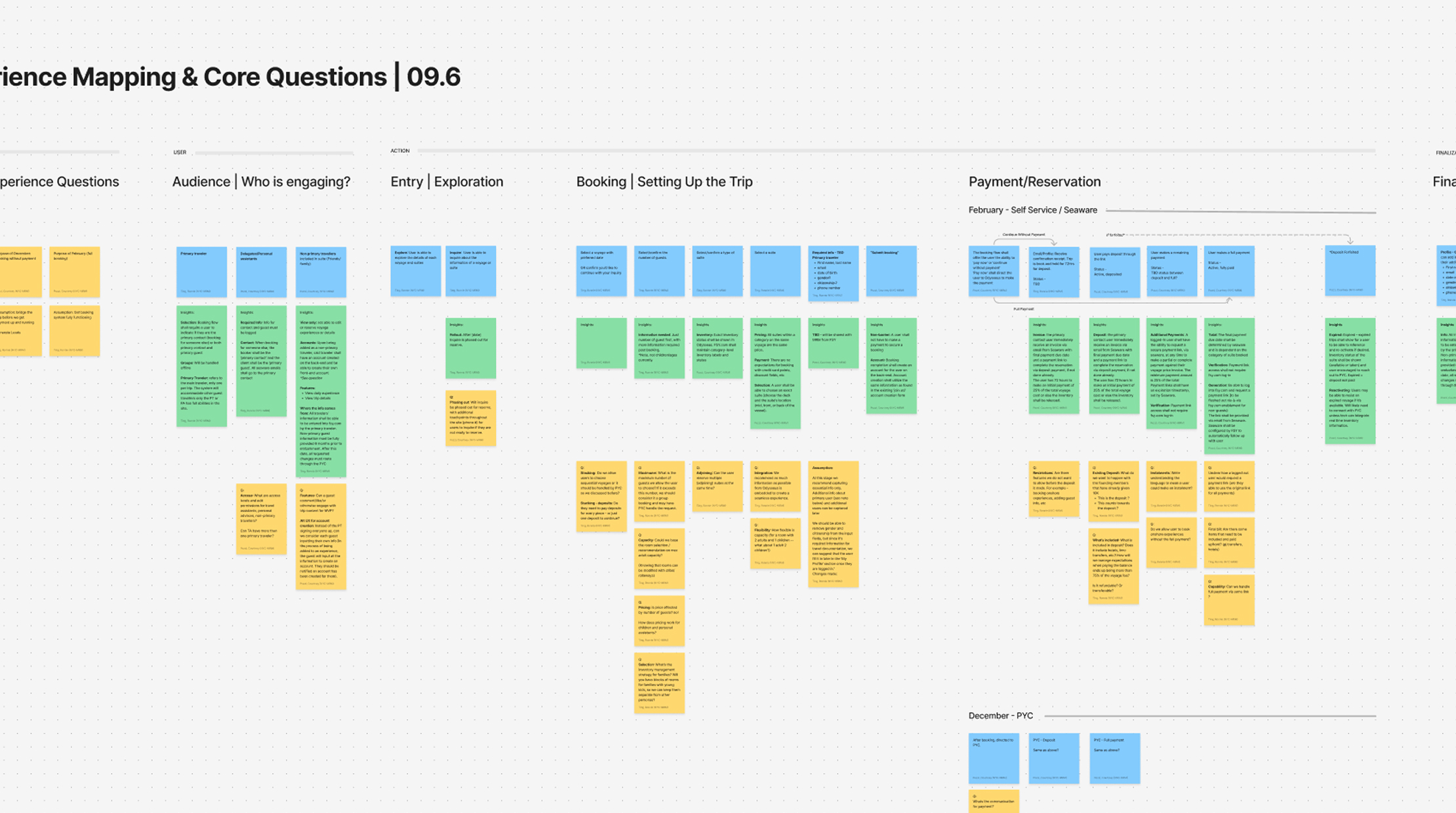
Experience Mapping
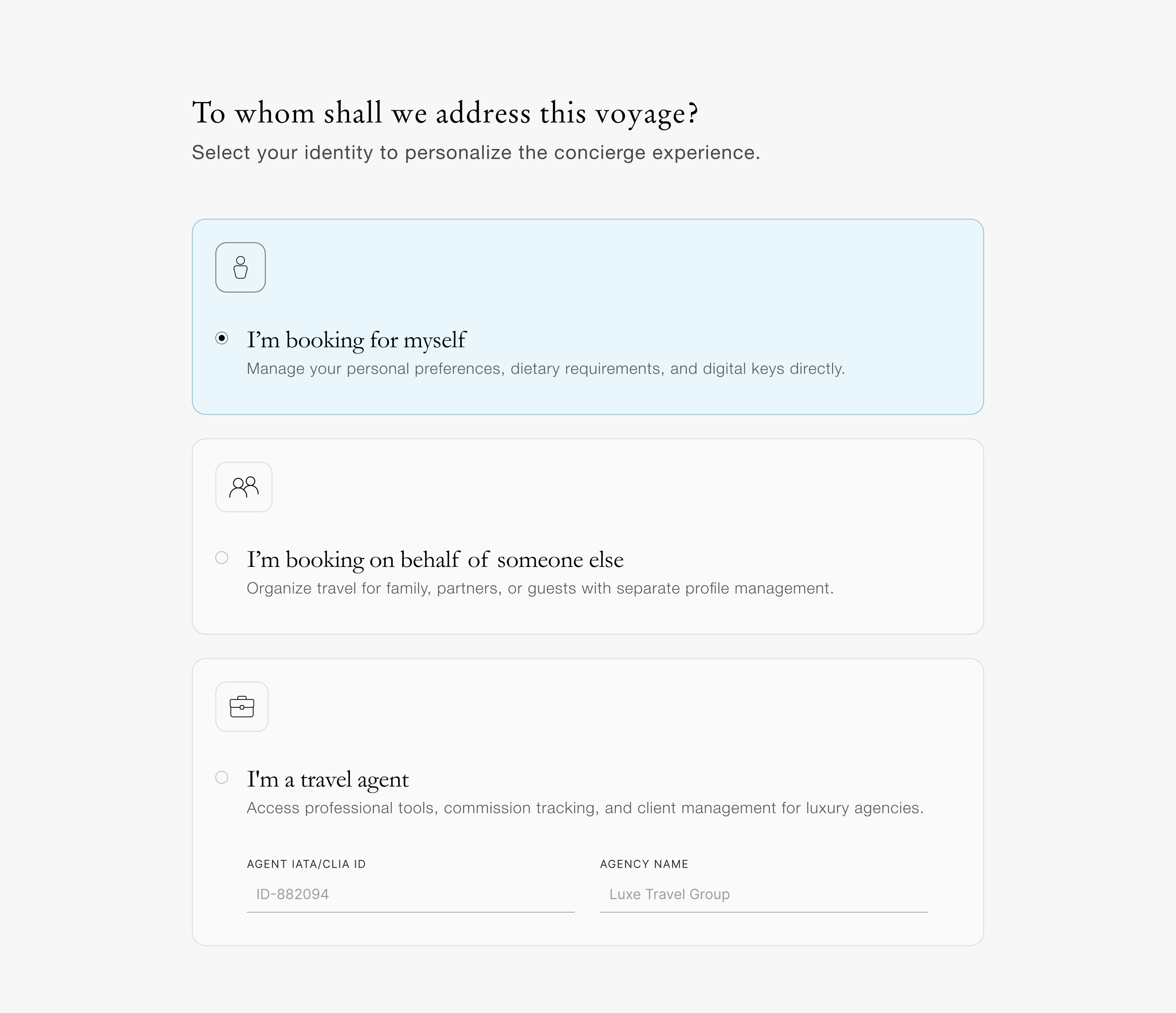
Three types of bookers, one coherent flow
We identified three distinct contexts in which a booking gets made. Each has different needs, but the underlying system — suite selection, payment, guest assignment — is the same. The platform adapts its framing, not its structure.
Single suite or several: an inventory decision
Most guests fall into one of two simple cases. They're booking a suite for themselves — or they're booking multiple independent suites for a group traveling together. Different cabins, different guests, but no dependency between the rooms.
We designed these two cases as a single progressive flow. You start by selecting one suite. If you need more, you add them. The system builds a guest roster as you go, letting the organizer assign travelers to each cabin. No extra steps unless you need them.

Single Suite Selection
Connecting suites: a spatial decision
Connecting suites are a different design challenge entirely. It's not about choosing from available inventory — it's about understanding where rooms sit in relation to each other on a physical ship.
This need comes up most often with multi-generational families: grandparents and grandchildren who want to be close, a family with young children who need a door between rooms, or a guest traveling with a personal assistant who needs to be directly accessible. The requirement isn't just "two suites" — it's "two suites that are physically connected, or at minimum adjacent."
Our approach was to abstract the ship's layout into a connectivity model. Rather than presenting a full deck map, the system surfaces only what's relevant: which suites are available as connecting pairs, what the connection looks like (shared door, same corridor, adjacent on deck), and what that means in practice for the guest's group.
Users choosing suites based on connected configurations
Pay now, Pay a little bit now or pay later
At this price point, payment isn't a checkout step — it's a relationship. Guests may put down a deposit months before sailing, with a balance due closer to departure. Some pay in full immediately. Some are managing payments across multiple parties in a group.
We designed the payment experience around three states — full payment, deposit with balance tracking and hold(reservation only) — and surfaced all of this clearly within the guest's profile. The deposit tracker shows balance due, upcoming reminders, and a direct path to completing payment, so nothing falls through the cracks in the months between booking and departure.
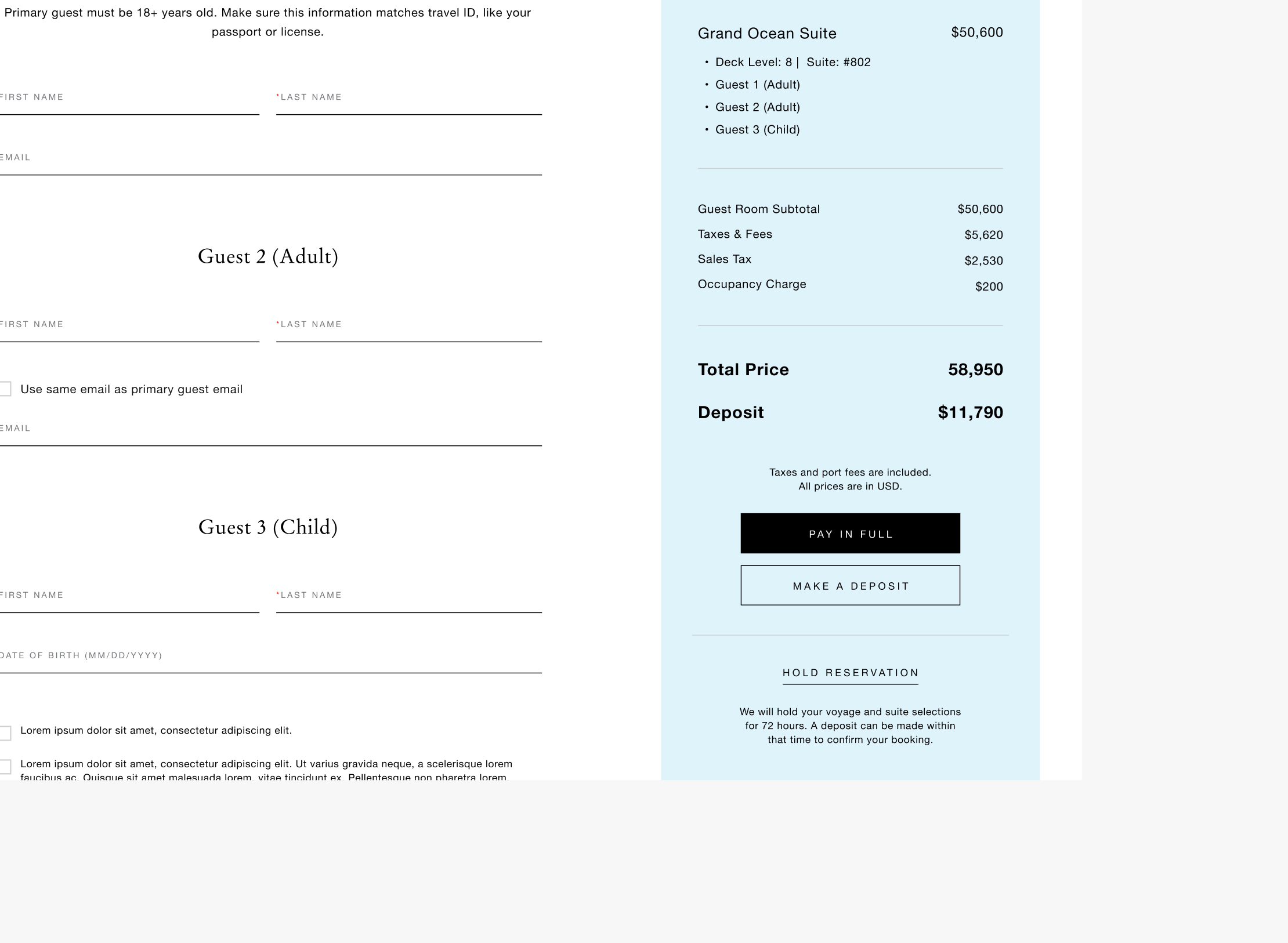
full payment, deposit or hold(reservation only)
My Profile becomes a living document
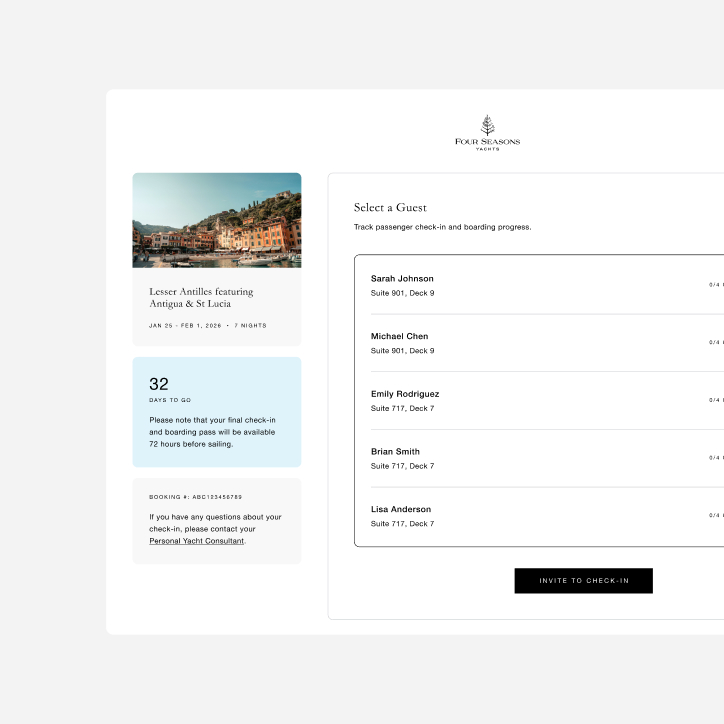
After confirming, guests land in a profile that holds everything: their suites, the guests assigned to each, dietary preferences, wellness goals, celebration notes, and payment status.
For group bookings, the guest and suite overview gives the organizer a clear picture of who's in which cabin — and the ability to update that as plans change. Guests can self-manage their preferences without the organizer acting as a middleman. Everyone has the right level of visibility and the right level of control.
Plan my day
Shore excursions, spa reservations, and onboard experiences aren't afterthoughts — for many guests, they're the reason for the trip. We created "Plan my day" as a dedicated experience layer that sits inside the booking.
Rather than presenting a catalogue of options, we framed it as an itinerary builder: here is your day, here is what's possible at each port, here is what you've reserved. Guests can browse, reserve, and adjust experiences the same way they'd manage a personal calendar.
"Plan my Day" experience builder
See Also
Four Seasons
Designing the Arrival Experience
Coming soon